
There is a special kind of journey that begins with the Atlantic breeze of Portugal, continues through the sunlit streets of Spain and eventually crosses into Morocco, where the landscape, language and rhythm of daily life suddenly change.
Spain, Portugal and Morocco are close on the map, but they do not feel the same. That is exactly what makes traveling between them so rewarding.
One journey can take you from Portuguese cafés to Spanish plazas, from historic Andalusian architecture to Moroccan souks, and from European Atlantic coastlines to North African mountains and deserts.
This is not simply a trip that checks three countries off a list.
It is a journey through contrasts.
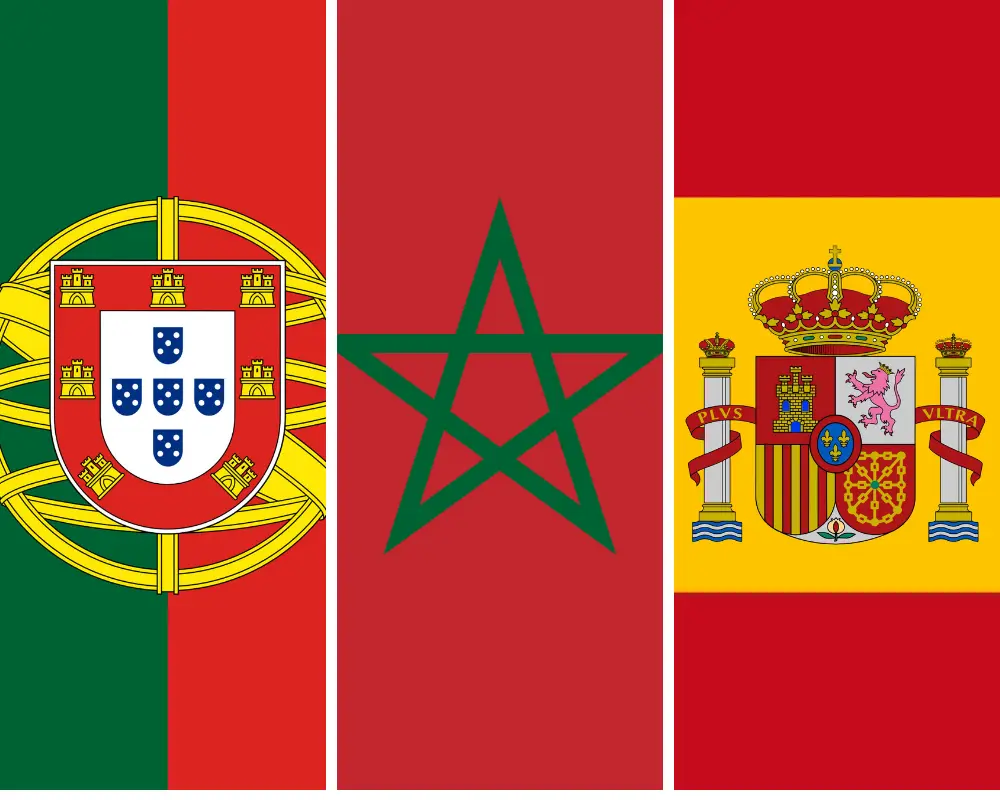
Portugal is an excellent place to begin because it introduces the traveler to the western edge of the Iberian Peninsula at an easy pace.
Lisbon is a city of hills, viewpoints, tiled façades and neighborhoods where modern life exists alongside centuries-old streets. Rather than trying to see the entire city in a single day, allow yourself time to wander.
Look for small cafés, neighborhood bakeries and viewpoints away from the busiest tourist areas.
Then travel beyond Lisbon.
Sintra offers a completely different atmosphere, with wooded hills and extravagant historic estates. Along the coast, the landscape becomes more dramatic, with cliffs, beaches and Atlantic horizons.
For travelers planning a Spain Portugal Morocco vacation, Portugal can provide the relaxed beginning before the journey becomes more intense.
Spain is too diverse to experience properly in a few days, so the smartest approach is to choose a region.
For a journey continuing toward Morocco, southern Spain makes particular sense.
Andalusia gives the trip a historical depth that becomes even more interesting after arriving in Morocco in Tangier city.
Seville is full of courtyards, plazas, orange trees, music, and late-evening energy. Córdoba adds another layer of history, while Granada sits beneath the Sierra Nevada and offers one of the most remarkable architectural experiences in the region.
But the real attraction is not simply individual monuments.
It is the feeling of moving through a region where different civilizations have left visible traces.
That makes southern Spain a natural chapter in a Spain-Portugal-Morocco itinerary.
Eventually, the map stops feeling like a map.
The Mediterranean and Atlantic meet around the Strait of Gibraltar, and Europe sits remarkably close to Africa.
This is one of the most interesting aspects of a Spain to Morocco trip.
You are not traveling thousands of kilometers to reach a completely different continent. You are crossing a relatively narrow stretch of water and entering a place with its own languages, traditions, architecture, and rhythms.
The crossing is therefore more than transportation.
It becomes part of the experience.
Morocco should not be treated as simply an extension of a European vacation.
It deserves its own pace.
Tangier is a fascinating starting point because its location has made it a meeting place between Africa, Europe and the Mediterranean for centuries.
From there, travelers can move toward the Rif Mountains and discover Chefchaouen, whose blue-painted streets have made it one of Morocco’s most recognizable towns.
But photographs only tell part of the story.
The real pleasure comes from walking without rushing, noticing handmade objects in small shops, drinking mint tea and watching ordinary life unfold around you.
Fes rewards travelers who are willing to put the itinerary aside for a while.
Its historic medina is a maze of streets, workshops, food stalls, courtyards and traditional architecture.
Rather than asking how many attractions you can visit, ask how much of the city you can experience.
Listen to the sounds of artisans working.
Notice the changing smells as you move between bakeries, spice shops and restaurants.
Look at the details around doorways and courtyards.
This is where Morocco travel becomes less about sightseeing and more about observation.
Marrakech brings a different kind of energy.
The city is famous internationally, but popularity has not removed its character.
The medina remains one of the main reasons people visit.
Markets fill the streets with color.
Traditional architecture appears behind unassuming entrances.
Food smells travel through the lanes.
And public spaces become increasingly lively as evening arrives.
The best Marrakech experience comes from balancing activity with quiet.
Spend time in the markets.
Then return to a peaceful riad.
Explore the city.
Then sit somewhere and watch it.
Accommodation can become part of the destination in Morocco.
A riad is typically organized around an interior courtyard, creating a peaceful environment behind the walls of the medina.
For many travelers, this contrast becomes one of the most memorable parts of visiting Marrakech or Fes.
Outside: noise, movement and narrow streets.
Inside: a courtyard, plants, traditional decoration and quiet.
When choosing accommodation, location matters as much as appearance.
A beautiful property that is difficult to reach may create unnecessary stress.
One of the strongest reasons to combine these countries is the food.
The culinary transition is almost as dramatic as the geographical one.
Portugal brings Atlantic influences, seafood, pastries and traditional comfort food.
Spain introduces regional cooking, tapas culture and long social meals.
Morocco adds spices, slow-cooked dishes, fresh bread, couscous, tagines and mint tea.
The important thing is not to search only for famous dishes.
Eat locally.
Try regional specialties.
Visit markets.
Ask restaurant staff what they recommend.
A memorable meal does not need to be expensive.
Marrakech can also serve as a gateway to Morocco’s mountain landscapes.
The Atlas Mountains provide a dramatic contrast to the urban environment.
Within a relatively short journey, the scenery changes from busy streets to valleys, villages and mountain roads.
For travelers who enjoy hiking or nature, this can be one of the most rewarding additions to a Morocco itinerary.
It also provides a useful break from sightseeing.
After several historic cities, spending a day surrounded by mountains can reset the pace of the trip.
Visit markets.
Ask restaurant staff what they recommend.
A memorable meal does not need to be expensive.
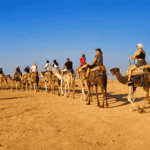
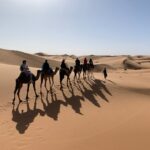
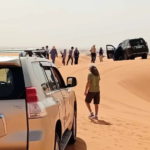
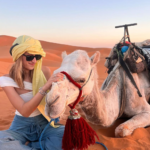
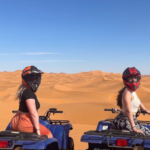
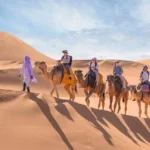
The Sahara is one of Morocco’s most famous travel experiences.
But adding it requires realistic planning.
The desert is not immediately outside Marrakech.
Depending on where you want to go and what kind of experience you want, reaching the desert can require significant travel time.
That means the Sahara makes more sense on a longer trip.
If you have only ten days for Spain, Portugal, and Morocco, forcing a desert tours from Marrakech may leave you exhausted.
If you have three or four weeks, however, it can become a spectacular part of the journey.
The rule is simple:
Do not add the Sahara desert Morocco because you feel you have to. Add it because you genuinely want the experience.
Ask restaurant staff what they recommend.
A memorable meal does not need to be expensive.
After busy cities and inland travel, Essaouira can provide a completely different final chapter.
The Atlantic becomes the main character again.
The historic medina, fishing activity and coastal atmosphere create a slower rhythm.
For some travelers, ending the trip beside the ocean is more satisfying than finishing with another major city.
It gives you time to reflect on everything you have experienced.
After busy cities and inland travel, Essaouira can provide a completely different final chapter.
The Atlantic becomes the main character again.
The historic medina, fishing activity and coastal atmosphere create a slower rhythm.
For some travelers, ending the trip beside the ocean is more satisfying than finishing with another major city.
It gives you time to reflect on everything you have experienced.
The biggest challenge with a Spain, Portugal and Morocco itinerary is not deciding where to go.
It is deciding what to leave out.
Trying to visit Lisbon, Sintra, Seville, Córdoba, Granada, Tangier, Chefchaouen, Fes, Marrakech, the Atlas Mountains, the Sahara and Essaouira in one short vacation can turn an exciting journey into a series of transfers.
A more relaxed trip might look something like this:
The ideal length depends less on how many countries you want to visit and more on how you like to travel.
If you enjoy slow mornings, long meals, and wandering without a schedule, give yourself more time.
If you prefer a fast-paced cultural journey, you can cover more ground—but leave some breathing room between major destinations.
The easiest way to plan this trip is to think of it as a continuous geographical story rather than three separate vacations.
Start in Portugal and gradually move south and east through Spain before crossing into Morocco.
This keeps the journey logical and allows the landscape and culture to change naturally.
You should also avoid underestimating travel days.
A destination may look close on a map, but border crossings, ferry connections, train journeys, and mountain roads can take considerably longer than expected.
Whenever possible, avoid scheduling an important activity immediately after a long transfer.
Give yourself time to arrive.
That extra space in the itinerary can make a surprisingly large difference to the overall experience.
Perhaps the most memorable part of traveling through Spain, Portugal and Morocco is the change in rhythm.
Portugal can feel relaxed and Atlantic-facing.
Spain, particularly Andalusia, brings a lively combination of plazas, food, architecture and social life.
Morocco introduces another sensory world: narrow medina streets, calls to prayer, mint tea, markets, handmade crafts, courtyards, and landscapes that shift dramatically from mountains to desert to coast.
None of these experiences needs to be compared.
They are valuable precisely because they are different.
The journey works because each country adds another layer.